By: *Prof. Mahmood Ahmad Tak*
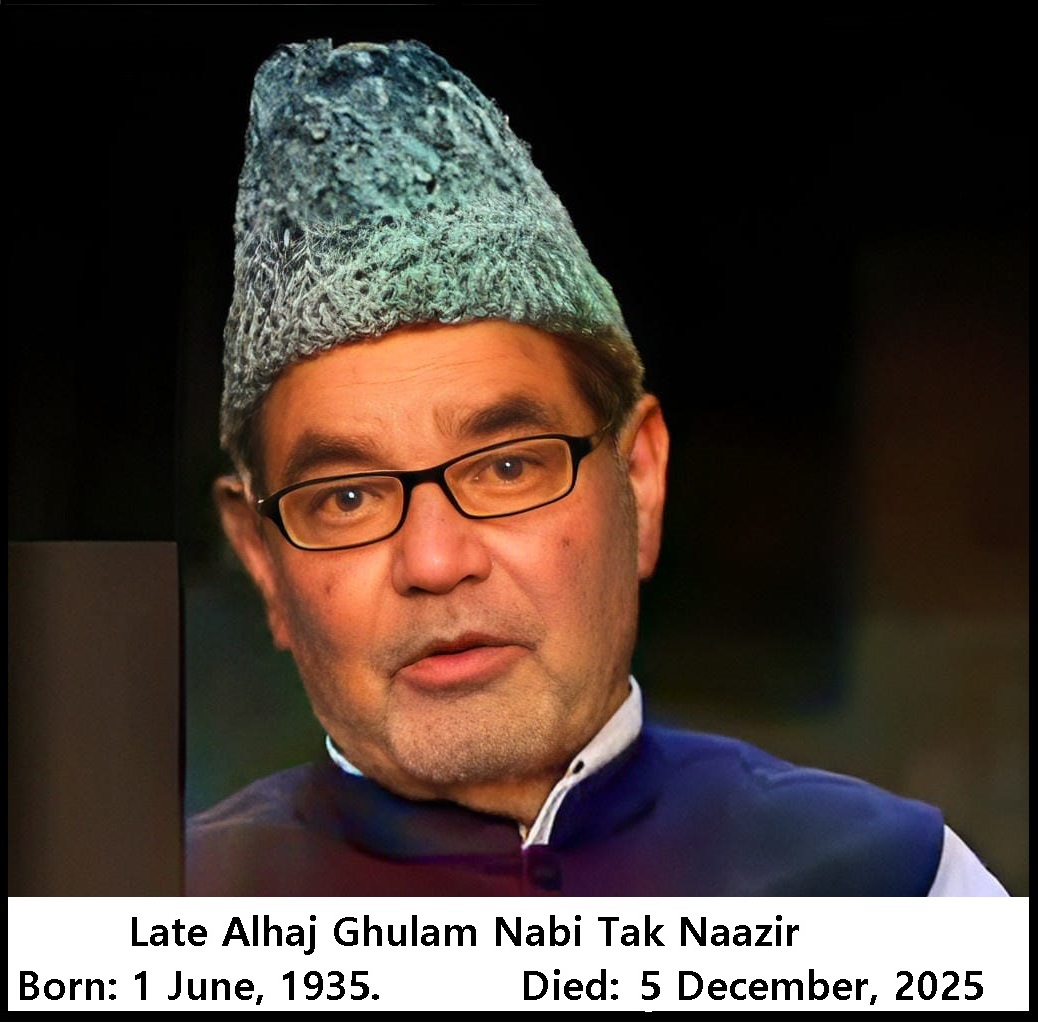 Much has been said and written about my dad, and much will continue to be written about him in the future as well. Those who were close to him, or knew him through his poetry and his work, will always write about his poetic and literary contributions and about his personality as a human being. But for me, he was simply my father—a very successful father, a very affectionate father, a very loving father, and a very caring father.
I clearly remember my childhood days, when my brothers, my sister, and I would feel proud to have a father who was an institution for us. He was a complete institution. We learnt countless lessons from him; we learnt reading, writing, and even speaking different languages at home because of him. I remember that I was less than three years old when he started teaching me Yassarnal-Quran, and by the age of four I could read the Holy Quran. The same was true for all of us. This was the first education we received at home. And this was followed by Urdu and English, and even Hindi. All of us brothers could read and write these languages—English, Urdu, Hindi, and Kashmiri—and all this we learnt from our father.
At the age of four I was admitted to a local private school for some time, and then to a Government School. I could already read and write all the books of the syllabus, which surprised my teachers. And I still remember that our real school was our father. This was the true education given to us by him. All of us brothers would stand first in our respective classes. My elder brother and sister were older, but my younger brother and I would study almost together, being just one class apart.
After studying in local schools for 2–3 years, my younger brother Munawar and I were shifted to a well-reputed English Medium school in Anantnag town called Montessori School (at that time there were only a few English Medium schools in the entire South Kashmir). There too, when we took the admission test, we qualified it easily. Let me mention here that we two brothers were the first students from our area to attend an English Medium school 17 km away from home—and it was only our dad who could afford to send us there; not because he was wealthy, but because he was deeply concerned about our education. He was a government employee, and his salary was the only income, yet he took this bold step to provide us with the best possible education—something very few could afford at the time.
Our father’s care for his children was so profound that he would come to our school at least once a week and obtain reports from our teachers and the Principal regarding our performance. Then he would come to our class and entertain all the students with humorous poems and folk tales. One such tale I still remember, which was later memorized by many students, was “Gagur te Gager.”
‘Soni gagri rope gagri gaykhi sone gadi malinui…’
His unique style of relating this and other tales was so entertaining, so engaging, and also so tongue-twisting. He became so popular in our school that almost every student knew him.
At home as well, he would narrate stories and entertain us with his poetry at a time when there were very few sources of entertainment compared to today. He was strict, yet extremely loving and caring, and had a wonderful sense of humour.
For us, he was also a full-fledged tutor. He helped us complete our homework, and then he would teach us every single subject himself. He would teach English, Mathematics, Science, Social Science, and even Art. I still remember how he explained scientific concepts, and how he taught geometry and algebra. He did not originally know all subjects, but in order to teach us, he would learn everything himself first and then teach us with minute details. It was at that time that he bought the famous Random House Dictionary for us, when it was not easily available. He subscribed to many magazines and journals—Science Reporter, Science Today, India Today, Illustrated Weekly of India, etc. This reflected his deep concern for our knowledge and education.
We also had a separate class for religious and moral education. In addition to teaching us the Holy Quran every morning, he would conduct separate religious classes, teaching different topics about religion and morality, and helping us memorise Surahs. In winters, he would organise special night sessions for us, which he called “Mehfil-e-Shabina,” in which we were given various topics to speak on. Our mother would often preside over these meetings while our father conducted the proceedings. It was an organised and meaningful activity. We learnt immensely from these home-based programmes.
My father was so loving that he never let us feel disappointed. Whenever we needed something, he would first assess its necessity. Then, if it was required, he would do everything possible to provide it. He was a living example of “simple living and high thinking,” and would constantly teach us the essence of simplicity. He was never fond of luxuries, but was deeply committed to education and intellectual growth. We lived a very simple life in a kacha house that was our sweet home. My father did not accumulate wealth, acquire land, or build property. Instead, he did everything he could to give us quality education. It was his mission and passion. And that is how all of us brothers and our sister received good education and became well settled in our respective fields.
After my elder brother’s and sister’s marriage, and after my elder brother moved to Srinagar, the entire responsibility of my parents fell on my shoulders. I was still at the University pursuing my M.Phil. I had to complete my studies and also take care of my parents. After my marriage, my spouse and I took care of them together. There was such a deep bond between my spouse and my mother that she never treated her as a daughter-in-law, but as a daughter; and my spouse never treated her as a mother-in-law, but as a mother. The same loving bond existed with my father. I was blessed with two daughters, Saira and Atiya; both were very dear to my parents, especially my father, and there was a very sweet association among all of us. I hardly ever worried about my daughters, because my father took care of everything. And I did not worry about my parents either, because my spouse and daughters were always there to look after them.
Though the story needs a more detailed narration—which would require much more time and space—let me now mention some important memories and experiences with my dad during the last few days of his life.
My father had a heart problem for the last twelve years of his life. After various diagnostic tests, including angiography, he was diagnosed with diffuse triple vessel disease. He was under treatment and had improved up to 90%, and his condition was still improving. He was diabetic for the last 5–6 years as well, which too was under control. But in the last few months, he developed neuropathy and would experience weakness in his legs. Yet, he continued to exercise every morning.
He would rise at midnight daily to offer Tahajjud prayers—something he had been doing regularly for more than thirty years. Then he would do some exercises, offer Fajar prayers, walk in the compound for about half an hour, drink 2–3 glasses of water, and then have his breakfast. This routine was the secret of his health and stamina.
There was another health issue he had been facing, but he did not disclose it to any of us until his final days.
On 27 November 2015, when I returned home from my office, I unknowingly went upstairs to my own room before entering his room. Later, when I went to him and greeted him, he did not reply; he had noticed that I had gone upstairs without meeting him, and he showed his displeasure. He had a tooth problem and had visited the dentist, but the pain had worsened. The dentist advised him to take an analgesic. I suggested giving him an injection and prepared it, but he refused angrily. I called a pharmacist, Farooq, who often came to administer injections, and he gave him the injection, after which my father felt relief.
The next day, 28 November, he was fine and sat outside in the compound at his usual place where he spent most of his day writing. As I left for office, I called out from a distance, “I am leaving.” He stopped me, called me near, and asked, “Are you alright, son?” I replied yes. Then he said, “Last night I had a dream. I saw myself sitting on my bed, you were sitting beside me, and there was another old friend. Then I saw an unknown person pointing towards two bags hanging on the other side. He was saying something, but I do not remember.” After telling me this dream, he remarked, “I am not sure whether the two bags mean two days, two weeks, two months, or two years. But the time is limited now.” I reassured him and asked him to trust Allah.
On 29 November, a Sunday, I had bought a new car. When I parked it in the compound, he came out, blessed the car, and asked when I would take him for a ride. I replied smilingly that the car was meant for him.
That very night, around 3 a.m. on 30 November, while I was sleeping beside him, he woke me up to accompany him to the washroom. When we returned, he asked for his diary and pen from near the window. I told him it was not the right time to write, but he insisted. I gave him the diary and pen. He wrote a few verses and recited them to me:
ونے وولہ تس نشانِ مردِ مومن
ییس ییلہ موت وُٹھن پیٹھ اَسن آسِن
In the morning, he corrected it, and the final version became:
ونے اقبالہؔ سُند مومن نشانے
ییس ییلہ موت وُٹھو آسی اَسانے
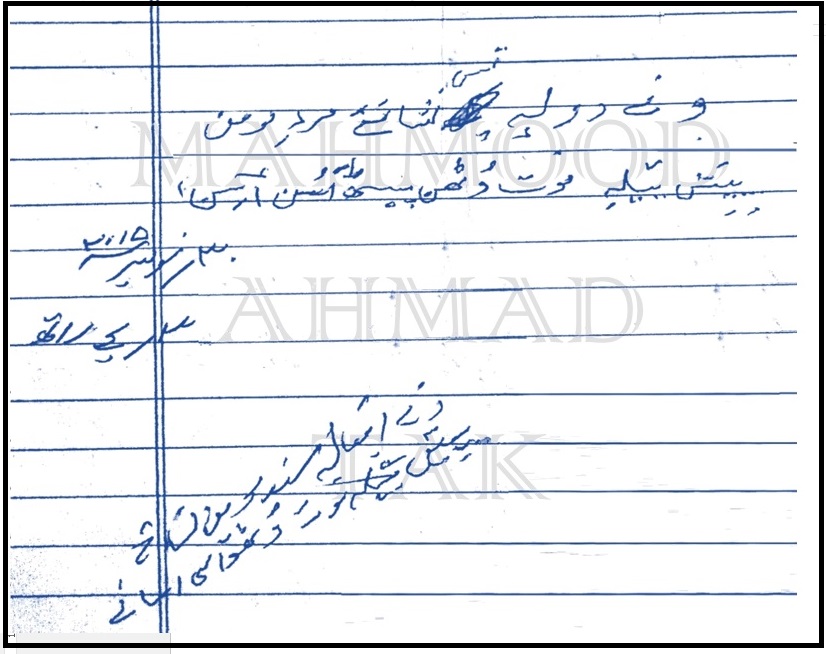
I later discovered that it was a Kashmiri translation of Allama Iqbal’s verse:
نشانِ مردِ مومن با تو گویم
چو مرگ آید تبسم بر لب اوست
He gave me the diary and asked me to keep it safe. I placed it securely in my cupboard.
Later that morning, he spent the entire day outside in the sun, writing. He told me he had resumed the Kashmiri translation of Kuliyat-e-Mehjoor. He had already translated many ghazals and was not sure whether he would be able to complete the work.
In the evening, he felt very cold and called me. He said he needed hospitalization. Only then did he tell me about the issue he had been silently suffering from for years—hydrocele testis. Although it was not a life-threatening condition, the discomfort and irritation were significant. The next day, 1 December, I took him in my new car to Kulgam Hospital. After examinations, he was advised surgery. One of my surgeon friends scheduled it for 3 December. I brought him home and gave the prescribed medications. He felt some relief.
At night, however, he became restless and irritable. I assumed it was discomfort from the hydrocele. His blood pressure and heart rate were normal, yet he remained uneasy. He wanted his bed shifted from one side to another. Then he wished to sleep on the floor, so we spread bedding there and he found some relief. Around 8 p.m., I woke him for food. His speech was slightly impaired. I grew worried but thought it was due to pain. He held my hands, kissed them repeatedly, and looked at me with deep affection. I fed him a few spoonfuls of food.
At about 2 a.m., he woke again. I turned on the light, and he expressed the need to use the washroom, and I accompanied him to the washroom. After returning, he slept soundly until dawn. Later in the early morning, he tried to vomit but couldn’t. He grew very uncomfortable and restless. I held him close and soothed him.
On 2 December, I took him to the local hospital. From there, he was referred to District Hospital Anantnag for a CT scan. He was diagnosed with Subdural Hemorrhage (SDH) and was immediately rushed to SKIMS Soura. This became his first and last ride in the new car.
At SKIMS, after tests, he was kept under observation for two days. He was in severe pain and given oxygen, but he frequently tried to remove the mask. Doctors wanted to operate but needed the hematoma to stabilise, since years of Aspirin use made surgery risky.
On the third day, he was shifted to Ward 5. He also developed a chest infection and was put on antibiotics. On this day—4 December 2015, my birthday—he seemed calm and peaceful. Although we never celebrated birthdays, my father always marked ours with Tahajjud prayers and a special dua. That day, as I sat alone beside him around 4 p.m., rubbing his forehead and gently combing his hair with my fingers, he held my hand, kissed it, and smiled. I felt as though he was silently saying, “Happy Birthday, my son.” It was a moment I will never forget.
By evening, he again felt breathless and was put on oxygen. His heart rate dropped, so he was shifted to a side room with continuous monitoring. Around 2:30 a.m., when the ward was quiet, I took him near the washroom with the help of attendants and changed his diapers and clothes. He seemed stable afterward.
At about 6 a.m., when I heard the Azan, I wanted to offer Fajar prayer, but was unable to go to the mosque. So, I prayed in a nearby corridor where some ladies were already praying. While praying, I had a strange feeling that my father was not going to survive.
When I returned, I felt extremely uneasy. I placed my hand on his forehead and began reciting Surah Yaseen from the Quran app on my phone. As I finished, I noticed his heart rate dropping. I called the doctor immediately. They tried to draw blood, but his vitals continued to decline. He was shifted to the ICCU.
At about 7:30 a.m. on 5 December 2015, my father breathed his last in the ICCU.
Inna Lillahi wa Inna Ilaihi Raji’oon.
He had expressed a wish that when buried, a pen and paper be placed near his head—to symbolise that he always stood for education and intellect. He had made my daughter Saira promise this. And this wish was fulfilled.
بوکھچہِ ہیتھ اوس سُہ ناظرؔ تہِ دوان
میٖلہ پچہِ دراو پنُن ناو لیٖکھِتھ
(ناظؔر)
May Allah grant him the highest place in Jannatul-Firdous. Aameen, Summa Aameen.
 takmahmood.blogs
I tell you.. Your account about my great uncle made me cry. After abbaji’s passing away I have shed tears today while reading this. He was great personality, a thorough gentleman, an intellectual with a passion for education. He was a great poet, a great writer and a pious soul. May Almighty Allah exalt him to the highest place in heaven.
LikeLiked by 1 person
Nice and really wonderful time every word shared with his father … U were really lucky enough to have such a great scholar as your father … A great gift from God you should be proud of…
LikeLiked by 1 person
Every living being on earth shall taste death. None can deny the fact …. May Allah give him highest place in jannah … Aameen 🤲
LikeLiked by 1 person
May Allah Grant him in Highest place of Jannat…
Such a Nice person and Amazing Dad ..
And My Favorite Ur also a Nice person like Your Father
LikeLiked by 1 person
A father is neither an anchor to hold us back, nor a sailor to take us there but a lighthouse the light of whose love shows us the way…
A father is a man who expects his children to excel and overtake him in every field and make him proud….
LikeLiked by 1 person
Trulee a dedicated father who gave up everything of him for ur bright future nd educated u oll for ur bright future.A true educationist who was constantly reading and educating himself nd his family and an affectionate part was played by ur mother by performing the duties for presiding over in Mehfil shabaina.may Allah shower his choicest blessing on both of them in jannat
LikeLiked by 1 person
A good father is one of the most unsung, unpraised, unnoticed, and yet one of the most valuable assets in our society.
“May Allah have mercy upon his soul and grant him the highest rank in Jannah…ameen ya Rabbul’Aalameen”.
LikeLiked by 1 person
While reading , tears were rolling down over my checks , parents are really most precious gift from almighty . May allah grant jannatul firdous to your father . Great love
LikeLiked by 1 person
May allah grant him in highest place of jannat….
LikeLiked by 1 person
May Allah accept all his good deeds and grant him highest place in jannah
LikeLiked by 1 person