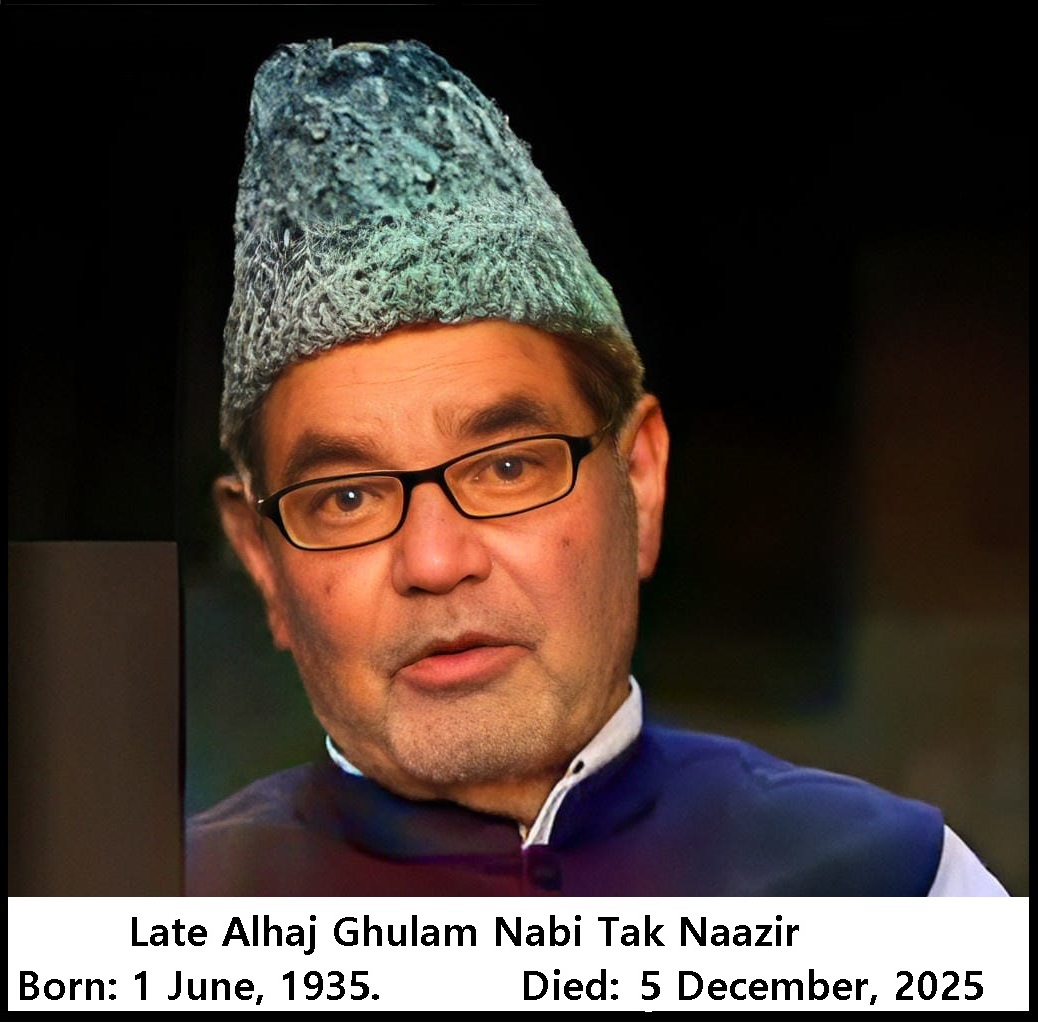
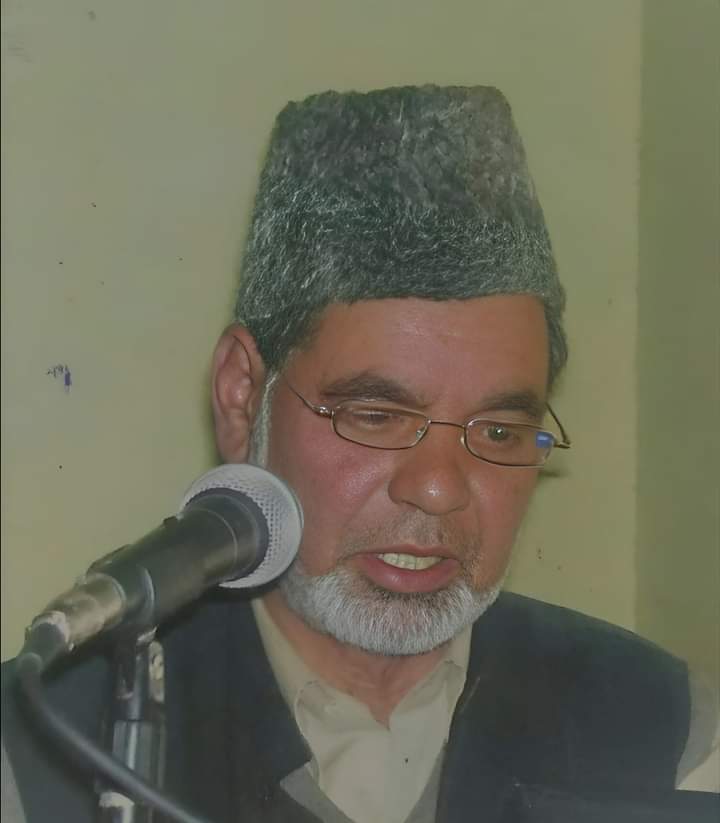
In Memory of My Beloved Father—Alhaj Ghulam Nabi Tak Naazir (Naazir Kulgami)

Nine winters have passed since that solemn morning of December 5, 2015, when at 7:30 AM at SKIMS Soura, my beloved father, Alhaj Ghulam Nabi Tak Naazir, known reverently as Naazir Kulgami, departed for his heavenly abode. Inna Lillahi wa Inna Ilaihi Raji’oon. May Allah grant him the highest place in Jannat-ul-Firdaus. Aameen.

A luminary whose brilliance illuminated not just Kashmir’s literary landscape but reached far beyond our valley’s peaks, my father stood as a colossus in the world of letters. His journey from a young poet in school to becoming one of Kashmir’s most distinguished literary figures is a testament to his extraordinary dedication to the written word. With more than 50 books encompassing poetry, criticism, research, and translation, he built a literary fortress that stands unshaken by time.

The Sahitya Akademi’s Best Book Award, among countless other honors, recognized his mastery, but perhaps his greatest achievement lay in the hearts he touched and the minds he shaped. His selection to represent Kashmir in numerous national multilingual poetic symposia spoke not just of his artistic excellence but of his ability to bridge cultures through the universal language of poetry.

His vision gave birth to Kashir Mahfil, where he tenderly nurtured hundreds of poetic saplings in Tehsil Kulgam. This garden of verse later blossomed into Maraz Adbi Sangam, co-founded with luminaries like Rasool Pompur, G.M. Shad, Naji Munawar and Mohan Lal Aash. Under his stewardship as founder President and later Lifetime Patron, the organization rose to become South Kashmir’s premier literary institution. The anthem he composed for Maraz Adbi Sangam remains a melodious testament to his devotion to literature and community.

Yet today, as we mark his ninth death anniversary, there is a profound sadness in witnessing the organization’s present leadership’s failure to honour their founding father. Their silence on this day echoes louder than words, their forgetfulness more painful than remembrance. But as his son, I know that true greatness needs no institutional validation. My father’s legacy lives not in ceremonial remembrances but in the countless lives he touched, the poets he mentored, and the literary treasures he left behind.

While the Organization named Maraz Adbi Sangam has forgotten its roots and have disheartened us with its failure to honour the memory of its founding father, I remain steadfast in my conviction that time will be a more faithful keeper of my father’s memory. His name will indeed be written in golden letters, not by those who forget, but by the enduring power of his words and the lasting impact of his contributions to Kashmiri literature.

Let those who choose forgetfulness walk their path. My father’s legacy soars above such earthly oversight, carried forward by the wind of time to inspire generations yet unborn. His spirit lives on in every verse penned in Kashmir, in every critical discourse on literature, and in the hearts of those who truly understand the power of words to transform lives.

May Allah bless his soul with eternal peace and grant him His divine proximity. Aameen.

In the words of the poet himself:

“The ink of my pen may dry,
But the words I’ve written will fly,
Beyond these mountains high,
Where time itself shall testify.”

@— Mahmood Ahmad Tak

My Dad—Ghulam Nabi Naazir (Some experiences and memories)

By: *Prof. Mahmood Ahmad Tak*
Much has been said and written about my dad, and much will continue to be written about him in the future as well. Those who were close to him, or knew him through his poetry and his work, will always write about his poetic and literary contributions and about his personality as a human being. But for me, he was simply my father—a very successful father, a very affectionate father, a very loving father, and a very caring father.

I clearly remember my childhood days, when my brothers, my sister, and I would feel proud to have a father who was an institution for us. He was a complete institution. We learnt countless lessons from him; we learnt reading, writing, and even speaking different languages at home because of him. I remember that I was less than three years old when he started teaching me Yassarnal-Quran, and by the age of four I could read the Holy Quran. The same was true for all of us. This was the first education we received at home. And this was followed by Urdu and English, and even Hindi. All of us brothers could read and write these languages—English, Urdu, Hindi, and Kashmiri—and all this we learnt from our father.

At the age of four I was admitted to a local private school for some time, and then to a Government School. I could already read and write all the books of the syllabus, which surprised my teachers. And I still remember that our real school was our father. This was the true education given to us by him. All of us brothers would stand first in our respective classes. My elder brother and sister were older, but my younger brother and I would study almost together, being just one class apart.

After studying in local schools for 2–3 years, my younger brother Munawar and I were shifted to a well-reputed English Medium school in Anantnag town called Montessori School (at that time there were only a few English Medium schools in the entire South Kashmir). There too, when we took the admission test, we qualified it easily. Let me mention here that we two brothers were the first students from our area to attend an English Medium school 17 km away from home—and it was only our dad who could afford to send us there; not because he was wealthy, but because he was deeply concerned about our education. He was a government employee, and his salary was the only income, yet he took this bold step to provide us with the best possible education—something very few could afford at the time.

Our father’s care for his children was so profound that he would come to our school at least once a week and obtain reports from our teachers and the Principal regarding our performance. Then he would come to our class and entertain all the students with humorous poems and folk tales. One such tale I still remember, which was later memorized by many students, was “Gagur te Gager.”

‘Soni gagri rope gagri gaykhi sone gadi malinui…’

His unique style of relating this and other tales was so entertaining, so engaging, and also so tongue-twisting. He became so popular in our school that almost every student knew him.

At home as well, he would narrate stories and entertain us with his poetry at a time when there were very few sources of entertainment compared to today. He was strict, yet extremely loving and caring, and had a wonderful sense of humour.

For us, he was also a full-fledged tutor. He helped us complete our homework, and then he would teach us every single subject himself. He would teach English, Mathematics, Science, Social Science, and even Art. I still remember how he explained scientific concepts, and how he taught geometry and algebra. He did not originally know all subjects, but in order to teach us, he would learn everything himself first and then teach us with minute details. It was at that time that he bought the famous Random House Dictionary for us, when it was not easily available. He subscribed to many magazines and journals—Science Reporter, Science Today, India Today, Illustrated Weekly of India, etc. This reflected his deep concern for our knowledge and education.

We also had a separate class for religious and moral education. In addition to teaching us the Holy Quran every morning, he would conduct separate religious classes, teaching different topics about religion and morality, and helping us memorise Surahs. In winters, he would organise special night sessions for us, which he called Mehfil-e-Shabina,” in which we were given various topics to speak on. Our mother would often preside over these meetings while our father conducted the proceedings. It was an organised and meaningful activity. We learnt immensely from these home-based programmes.

My father was so loving that he never let us feel disappointed. Whenever we needed something, he would first assess its necessity. Then, if it was required, he would do everything possible to provide it. He was a living example of “simple living and high thinking,” and would constantly teach us the essence of simplicity. He was never fond of luxuries, but was deeply committed to education and intellectual growth. We lived a very simple life in a kacha house that was our sweet home. My father did not accumulate wealth, acquire land, or build property. Instead, he did everything he could to give us quality education. It was his mission and passion. And that is how all of us brothers and our sister received good education and became well settled in our respective fields.

After my elder brother’s and sister’s marriage, and after my elder brother moved to Srinagar, the entire responsibility of my parents fell on my shoulders. I was still at the University pursuing my M.Phil. I had to complete my studies and also take care of my parents. After my marriage, my spouse and I took care of them together. There was such a deep bond between my spouse and my mother that she never treated her as a daughter-in-law, but as a daughter; and my spouse never treated her as a mother-in-law, but as a mother. The same loving bond existed with my father. I was blessed with two daughters, Saira and Atiya; both were very dear to my parents, especially my father, and there was a very sweet association among all of us. I hardly ever worried about my daughters, because my father took care of everything. And I did not worry about my parents either, because my spouse and daughters were always there to look after them.

Though the story needs a more detailed narration—which would require much more time and space—let me now mention some important memories and experiences with my dad during the last few days of his life.

My father had a heart problem for the last twelve years of his life. After various diagnostic tests, including angiography, he was diagnosed with diffuse triple vessel disease. He was under treatment and had improved up to 90%, and his condition was still improving. He was diabetic for the last 5–6 years as well, which too was under control. But in the last few months, he developed neuropathy and would experience weakness in his legs. Yet, he continued to exercise every morning.

He would rise at midnight daily to offer Tahajjud prayers—something he had been doing regularly for more than thirty years. Then he would do some exercises, offer Fajar prayers, walk in the compound for about half an hour, drink 2–3 glasses of water, and then have his breakfast. This routine was the secret of his health and stamina.

There was another health issue he had been facing, but he did not disclose it to any of us until his final days.

On 27 November 2015, when I returned home from my office, I unknowingly went upstairs to my own room before entering his room. Later, when I went to him and greeted him, he did not reply; he had noticed that I had gone upstairs without meeting him, and he showed his displeasure. He had a tooth problem and had visited the dentist, but the pain had worsened. The dentist advised him to take an analgesic. I suggested giving him an injection and prepared it, but he refused angrily. I called a pharmacist, Farooq, who often came to administer injections, and he gave him the injection, after which my father felt relief.

The next day, 28 November, he was fine and sat outside in the compound at his usual place where he spent most of his day writing. As I left for office, I called out from a distance, “I am leaving.” He stopped me, called me near, and asked, “Are you alright, son?” I replied yes. Then he said, “Last night I had a dream. I saw myself sitting on my bed, you were sitting beside me, and there was another old friend. Then I saw an unknown person pointing towards two bags hanging on the other side. He was saying something, but I do not remember.” After telling me this dream, he remarked, “I am not sure whether the two bags mean two days, two weeks, two months, or two years. But the time is limited now.” I reassured him and asked him to trust Allah.

On 29 November, a Sunday, I had bought a new car. When I parked it in the compound, he came out, blessed the car, and asked when I would take him for a ride. I replied smilingly that the car was meant for him.

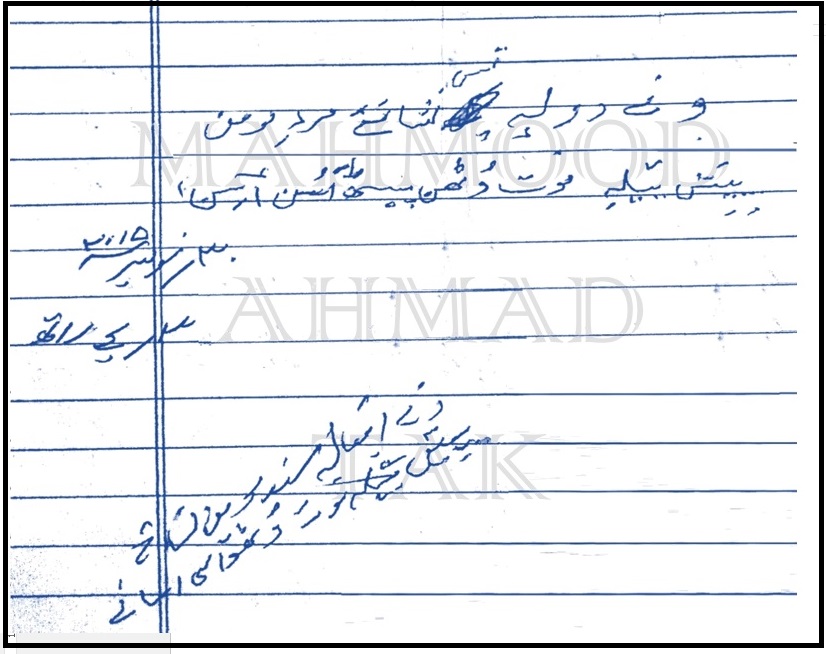
That very night, around 3 a.m. on 30 November, while I was sleeping beside him, he woke me up to accompany him to the washroom. When we returned, he asked for his diary and pen from near the window. I told him it was not the right time to write, but he insisted. I gave him the diary and pen. He wrote a few verses and recited them to me:

ونے وولہ تس نشانِ مردِ مومن
ییس ییلہ موت وُٹھن پیٹھ اَسن آسِن

In the morning, he corrected it, and the final version became:

ونے اقبالہؔ سُند مومن نشانے
ییس ییلہ موت وُٹھو آسی اَسانے
I later discovered that it was a Kashmiri translation of Allama Iqbal’s verse:

نشانِ مردِ مومن با تو گویم
چو مرگ آید تبسم بر لب اوست

He gave me the diary and asked me to keep it safe. I placed it securely in my cupboard.

Later that morning, he spent the entire day outside in the sun, writing. He told me he had resumed the Kashmiri translation of Kuliyat-e-Mehjoor. He had already translated many ghazals and was not sure whether he would be able to complete the work.

In the evening, he felt very cold and called me. He said he needed hospitalization. Only then did he tell me about the issue he had been silently suffering from for years—hydrocele testis. Although it was not a life-threatening condition, the discomfort and irritation were significant. The next day, 1 December, I took him in my new car to Kulgam Hospital. After examinations, he was advised surgery. One of my surgeon friends scheduled it for 3 December. I brought him home and gave the prescribed medications. He felt some relief.

At night, however, he became restless and irritable. I assumed it was discomfort from the hydrocele. His blood pressure and heart rate were normal, yet he remained uneasy. He wanted his bed shifted from one side to another. Then he wished to sleep on the floor, so we spread bedding there and he found some relief. Around 8 p.m., I woke him for food. His speech was slightly impaired. I grew worried but thought it was due to pain. He held my hands, kissed them repeatedly, and looked at me with deep affection. I fed him a few spoonfuls of food.

At about 2 a.m., he woke again. I turned on the light, and he expressed the need to use the washroom, and I accompanied him to the washroom. After returning, he slept soundly until dawn. Later in the early morning, he tried to vomit but couldn’t. He grew very uncomfortable and restless. I held him close and soothed him.

On 2 December, I took him to the local hospital. From there, he was referred to District Hospital Anantnag for a CT scan. He was diagnosed with Subdural Hemorrhage (SDH) and was immediately rushed to SKIMS Soura. This became his first and last ride in the new car.

At SKIMS, after tests, he was kept under observation for two days. He was in severe pain and given oxygen, but he frequently tried to remove the mask. Doctors wanted to operate but needed the hematoma to stabilise, since years of Aspirin use made surgery risky.

On the third day, he was shifted to Ward 5. He also developed a chest infection and was put on antibiotics. On this day—4 December 2015, my birthday—he seemed calm and peaceful. Although we never celebrated birthdays, my father always marked ours with Tahajjud prayers and a special dua. That day, as I sat alone beside him around 4 p.m., rubbing his forehead and gently combing his hair with my fingers, he held my hand, kissed it, and smiled. I felt as though he was silently saying, “Happy Birthday, my son.” It was a moment I will never forget.

By evening, he again felt breathless and was put on oxygen. His heart rate dropped, so he was shifted to a side room with continuous monitoring. Around 2:30 a.m., when the ward was quiet, I took him near the washroom with the help of attendants and changed his diapers and clothes. He seemed stable afterward.

At about 6 a.m., when I heard the Azan, I wanted to offer Fajar prayer, but was unable to go to the mosque. So, I prayed in a nearby corridor where some ladies were already praying. While praying, I had a strange feeling that my father was not going to survive.

When I returned, I felt extremely uneasy. I placed my hand on his forehead and began reciting Surah Yaseen from the Quran app on my phone. As I finished, I noticed his heart rate dropping. I called the doctor immediately. They tried to draw blood, but his vitals continued to decline. He was shifted to the ICCU.

At about 7:30 a.m. on 5 December 2015, my father breathed his last in the ICCU.
Inna Lillahi wa Inna Ilaihi Raji’oon.

He had expressed a wish that when buried, a pen and paper be placed near his head—to symbolise that he always stood for education and intellect. He had made my daughter Saira promise this. And this wish was fulfilled.

بوکھچہِ ہیتھ اوس سُہ ناظرؔ تہِ دوان
میٖلہ پچہِ دراو پنُن ناو لیٖکھِتھ
(
ناظؔر)

May Allah grant him the highest place in Jannatul-Firdous. Aameen, Summa Aameen.
The Deluge 2014 in J&K

The Deluge 2014 in J&K

 * Prof. Mahmood Ahmad Tak

The deluge in J&K in September 2014, which broke all the previous records both in Kashmir and Jammu provinces, has left a trail of destruction in almost every part of this already vexed state.  The flood havoc has left both the Jammu region and the Kashmir Valley equally ruined. The large-scale devastation and destruction has impacted every walk of life and there is hardly any family which has not been affected, directly or indirectly, by this completely unpredicted misery.

The state of Jammu & Kashmir has long been in the grip of natural disasters, especially the one that hit the state recently. Worst sufferers were the poor people who reside both in towns and villages and due to continuous heavy rains many of them lost their precious lives and shelters. Their crops totally vanished making the survivors very hard to survive in the coming days. They are now totally dependent on the help from the government or some social organizations that can come to their rescue in these hard times when the after effects of floods are seen everywhere.

The deluge actually started with the heavy monsoon rains on September 2, 2014 in Jammu and Kashmir region leading to heavy flooding. On September 3, a border security officer and five others were killed in landslides and flash floods triggered by heavy rains in Jammu region. On September 4, about 40 people were killed in a torrent that washed away a bus carrying the wedding party in the southern Rajouri district. The Jammu and Kashmir government sounded a flood alert for the state on September 4 after three days of incessant rain had flooded 23 villages. By September 6, some 390 villages were inundated and the death toll had risen to 150, as per the official reports. On September 7, the Prime Minister declared a national emergency. The reports claimed that it was the worst flood in the last 109 years.

Heavy rainfall caused flash flooding with localized damage across the state, landslides, which impacted on communities and road connectivity and widespread flooding in the Kashmir Valley. Flood waters breached embankments in many low-lying areas in Kashmir, including the capital Srinagar, forcing people to move to safer places. River Jhelum, River Chenab and many other streams were flowing above the danger mark. The worst affected districts were Kulgam, Anantnag, Pulwama, Budgam, Srinagar, Baramulla, Ganderbal, Rajouri, Poonch and Reasi. On the whole about five hundred human lives were reported lost. It was reported that 450 villages, with an estimated rural population of 823,281, were flooded, with farmlands being submerged. The Jhelum River had been flowing 4-5 feet above danger mark in Srinagar. Links of valley to the rest of the country were badly damaged and took about two weeks to open again. 300 km long National Highway had to be closed for vehicular traffic for many days because of landslides and floods. As many as 60 major and minor roads were cut off and over 30 bridges washed away, hampering the relief and rescue operations. Except for connectivity between Srinagar and north Kashmir’s Ganderbal district, all other districts of the valley including Anantnag, Pulwama, Kulgam, Shopian, Budgam, Baramulla and Bandipora were cut off. Due to heavy rains and floods the standing crops were totally damaged. Fields saturated in water and crops vanished making people of the State totally dependent on food from the relief agencies as their crops have been vanished due to this natural calamity.

Jammu and Kashmir is basically an agrarian economy, with 70% of the population dependent on agricultural activities. The state is known for its agricultural and mineral resources especially for the growth of Basmati rice. The fruit crops grown in the state include apples, cherries, pomegranates, peaches, pears, walnuts etc. Animal husbandry is also a source of income. Other sources of livelihoods include labour, small business, petty shop owners and artisans. Paddy and fruit crops have suffered huge losses, there are also reports of severe damage to vegetable and maize crops, the crops have either been lost or there has been a reduction in the yield. It is likely that the land may become unfit for agricultural production in the coming years. There has been potential loss of seeds and tools. Supply routes and transportation networks were severely affected that led to reduced availability of food stocks, increased prices and reduced access of households to food.  Access issues also hampered the Integrated Child Development Services and Public Distribution System. Flooding has had a major impact on household level food stocks, with water logging causing damage to dry storage, and flash floods washing away household assets. The poorest survive by buying and cooking food daily, maintaining limited storage of food supplies. Flooding also caused major loss of livestock.

Water sources remained inundated and got contaminated. Displaced populations in alternate shelters were devoid of safe drinking water. After the floodwater receded, there was water logging for more than a week in the low level areas, leading to the problem of water contamination. Overflow of pit latrines and sanitation practices continued to be at risk after water receded. Government sources also indicated that groundwater is contaminated which may indicate a need for continued water treatment or long term solutions.

Srinagar city has been the worst hit by the floods and the damage suffered by the summer Capital is more than the aggregate of losses in other affected districts of Kashmir. While Srinagar tops the devastation in the housing sector, the losses in the business sector are feared to be even bigger as the commercial hub of Lal Chowk and its neighborhood were also deluged and markets are still far from resuming normal life.

Official reports claim that as many as 72, 291 houses have been listed as damaged in the City alone whereas the aggregate of dwellings damaged in other nine affected districts including Pulwama, Anantnag, Shopian, Kulgam, Bandipora, Ganderbal, Baramulla and Kupwara is around 68,000. In Srinagar, at least 5,010 houses were fully damaged while the figure could rise as some victims have demanded fresh survey.

The devastating floods have dealt a severe blow to the educational infrastructure of the state with about 4,600 government and 1,500 private schools damaged in Kashmir division according to the official reports. Across Jammu division, about 1,200 government schools were damaged. Of these, 200 buildings have either been washed away or fully damaged and over 1,000 are partially damaged. The schools in low-lying areas in 70 villages in Jammu were inundated. The three districts including border districts of Jammu, Rajouri and Poonch have suffered extensive damage to school buildings.

The floods have dealt a heavy blow to Kashmir’s higher education sector as well, with losses amounting to over Rs 100 crores. The floods have hit hard 10 colleges in Kashmir, seven in Srinagar and three in Anantnag districts. The floods have destroyed everything in these 10 colleges, be it their laboratories, libraries, classrooms or offices. The affected colleges cater to 18 percent of entire college-going students of Kashmir. Estimates indicate that the floods have directly affected 20,000 students in the valley. The damage is so severe in the colleges that the Higher Education department is still unable to decide where to start from again and how. Barring Govt. Women College Nawakadal, all the colleges in Srinagar remained inundated for several days. Similarly in South Kashmir, GDC Bijbehara, GDC (Boys) Anantnag and GDC for women Anantnag were severely affected by the floods. Some of the worst affected colleges in Srinagar include Amar Singh College, S P College, Women College M A Road, Gandhi Memorial College and GDC Bemina. Other colleges like Islamia College of Science and Commerce at Hawal has also suffered structural damage during these floods. The laboratories, libraries and other infrastructure worth crores has been lost. In Jammu there were few incidents of structural damages and all colleges are functional.

We are presently in the post-disaster phase of the recent hit disaster, facing the after effects of the deluge. It is not that we have faced a disaster for the first time…!!! We have faced disasters in the past, even in the recent past. We have still not forgotten the snowstorm and ferocious blizzard of Waltengo Nar in Qazigund in February 2005 that killed 162 persons and people were starved off for several days. The memories are still fresh in the minds of the people of the devastation that was caused as a result of the massive earthquake on October 8, 2005 in which there was a huge loss of life and property.

This flood has been termed as a disaster of “international magnitude” by the government, which affected more than a million people across Kashmir. With thousands of families in flood-affected areas of Kashmir continuing to remain displaced and a humanitarian crisis looming large, children are being seen as the worst sufferers of the calamity. The flood, which killed hundreds, left thousands of people homeless and bruised the psyche of millions, is particularly seen to have a lasting impact on the psychology and general healthcare of children, according to studies and experts. Analysts also believe that if basic amenities like food, shelter and medicine are not provided to the affected children, it will affect them badly in future and the repercussions could be shocking given the images of devastation embedded in their minds.

All natural disasters cause loss in one way or the other depending on the severity. Lives are lost in disasters. Falling of buildings or trees, freezing to death, being washed away are just some of the deadly effects. Some disasters cause more loss of life than others. Then there is a loss of property which affects people, living quarters, transportation, and livelihood. And every time a disaster strikes us, we become conscious as to how we should prepare ourselves for any disasters in future. But then, after some years we forget everything and become ignorant. It is high time to understand the intensity of the devastation that is caused by these disasters and become disaster prepared to face any disasters in future as well, for we are living in disaster prone area. Natural disasters are a part of life as we know it. However, science is making it more possible to predict and helping us to learn to face these disasters with minimum losses.

Chronology of some major events:

  1. September 2: Heavy monsoon rains lashed J&K, including the summer capital Srinagar.
  2. September 3: Heavy rains continued for the second consecutive day, triggering flood threat across the Valley.
  3. Flashfloods triggered by incessant rains wreaked havoc in Poonch and Rajouri districts of Jammu, forcing the administration to sound an alert in several areas.
  4. Heavy rains triggered landslides in Jammu, killing a border security officer and five others.
  5. The water level in Chenab, Jhelum and other major rivers and streams like Vaishaw, Sandran, Lidder, Toungri and Vaishav nallahs in the State rose overnight. The water level of Jhelum River at Sangam rose above danger mark (22 ft).
  6. A Torrent washed away a bus carrying a wedding party, killing 50 people in the Lam-Darhal road in Nowshehra Tehsil of the southern Rajouri district.
  7. At least five persons, including four children and a woman, were killed after landslides hit three mud houses (dhoks) of nomads at Kala Jhar area in Mahore tehsil.
  8. Two persons died after being washed away in local streams while 100 houses located close to a river in Poonch town were washed away.
  9. September 4: The Jammu and Kashmir government sounded a flood alert for the state after three days of incessant rain had flooded 23 villages in the Southern districts of Anantnag and Pulwama. The river Jhelum crossed the danger mark, inundating several more areas.
  10. After continuous spell of rains, flood waters breached embankments in many low-lying areas in Kashmir, including the summer capital Srinagar, forcing people to move to safer places. Jhelum River crossed 30-feet mark at Sangam in Anantnag—seven feet above danger mark. Jhelum touched 21.8 feet against the danger level of 18-feet at Ram Munshi Bagh.
  11. Many areas in Srinagar including Hamdania Colony in Bemina, Lasjan, Armwari, Kanlipora, Kursoo Rajbagh and Natipora were inundated after flood waters entered there. Safa Kadal, Eidgah, Nowshehra, Soura, Ali Jan Road, Gulshan Nagar, Mehjoor Nagar, Gogji Bagh, Wazir Bagh, Jawahar Nagar, Rajbagh and Bemina, were inundated later. Several important roads, lanes and by-lanes in the commercial hub of Lal Chowk were also submerged due to water-logging.
  12. September 5: The water level in Jhelum crossed 31-feet in Sangam. Dozens of villages in near Sangam including Marhama were also submerged.
  13. Many areas in the old Anantnag town and KP Road were also submerged in floodwater. Flood water also entered areas of Mattan Chowk, Dangerpora, Mehandi Kadal, Lal Chowk, Janglat Mandi, Achajipora, Moominabad, Iqbal Market, Bakshiabad, Laizbal, Anchidora, SK Colony, Achabal Adda, Naibasti and Khanabal.
  14. In Dooru and Shangus many houses collapsed after floodwater entered the area.
  15. Dozens of small bridges in Kulgam either collapsed or were washed away by the floods.
  16. A breach on Jhelum occurred at Kandizal in Budgam area, affecting a population of 70,000 souls. This has stabilized flood level at 21.8 feet at Ram Munshi Bagh in Srinagar for last four to five hours.
  17. Dozens of villages in Kokernag have been hit by landslides. Many villages have been cut off due to damage to bridges following flashfloods.
  18. Dozens of villages in Kakpora, Awantipora, Pampore and Tral were submerged in water.
  19. Rambiara Nallah in Shopian overflowing.
  20. At least 13 members of a family were killed Friday after massive landslides in Rajouri district.
  21. Three persons were killed when they were washed away in flashfloods in Sukhnag Nalla in central Kashmir’s Budgam district.
  22. September 6: Some 390 villages were inundated and the death toll had risen to 150, as per the official reports.
  23. September 7: Prime Minister declared a national emergency. The reports claimed that it was the worst flood in the last 109
  24. September 8: In many parts of Srinagar’s neighbourhood, the water was about 15 feet (4.7 m) deep, submerging entire houses.
  25. The death toll till September 10 had crossed 190 in Kashmir valley and areas affected by the floods were mostly districts in South Kashmir.

Summary of the Losses to Life and Property:

Total Population Affected by way of Communication, Accessibility, Availability of Supplies, Agriculture, Livestock, and Assets Losses 10,136,063
Population indirectly Affected indirectly by way of impact on roads, access, local economy, markets, availability of food, food price increases, contamination of water sources, public infrastructure 8,186,273
Population Affected directly (tangible and intangible) 1,949,790
 Deaths 450+
Direct loss of household assets, livelihood, Psychosocial 1,406,311
Total Houses completely damaged in Srinagar District: 72,291+
Total Houses completely damaged in other 9 districts including those of Anantnag, Kulgam, Shopian, Pulwama Budgam, Baramulla, Bandipora and Ganderbal 68,000+
Number of govt. educational institutions damaged in Kashmir 4,600
Number of private educational institutions damaged in Kashmir 1,500
Number of School buildings washed away or damaged fully in Kashmir (Buildings have either been washed away or fully damaged) 200
Number of School buildings damaged partially in Kashmir 1,000
Estimate of damages to Higher Education Sector Rs 100 crores.
No. of Colleges damaged in Kashmir, (7 in Srinagar and 3 in Anantnag District) 10
No. of Students affected directly (18% of the total college going students) 20,000